


Last Updated: November 1, 2026
Quick Summary
To verify product quality online, score each listing on five dimensions: materials and construction, specifications, review evidence, seller responsiveness and price plausibility, giving 0-2 points each out of 10. A score of 8-10 is a strong signal, 5-7 means proceed with care, and 0-4 means walk away.
- Score each of the five quality dimensions 0, 1 or 2 for a maximum of 10 points.
- Vague specs like premium material cap the Materials dimension at 1.
- Fake reviews are vague, glowing and clustered, while real ones mention time and specifics.
- Verify authenticity by matching model numbers and checking QR codes against the brand's official site.
- Report faults to the seller in writing inside the return window, even if you plan a warranty claim.
Table of Contents
- Why Product Quality, Authenticity and Seller Legitimacy Are Three Different Checks
- Your Online Product Quality Checklist Before You Buy
- How to Evaluate Product Reviews Without Getting Fooled
- How to Verify an Online Seller Before You Pay
- Quality Checks by Product Category: Fashion, Electronics, Beauty and Home
- After Delivery: Inspection, Evidence and Warranty Protection
- Shop With Confidence at Theclothes.club
- Frequently Asked Questions
Why Product Quality, Authenticity and Seller Legitimacy Are Three Different Checks
Most shoppers treat these as one question: "Is this a good buy?" They are three separate checks, and mixing them up is why people get burned. A listing can show perfect product quality and still be a counterfeit. A genuine item can come from a seller who vanishes after payment. A trustworthy seller can stock a weak product.
Here is the distinction that matters:
- Product quality is how well the item is made and how it performs.
- Product authenticity is whether it is the real branded item or a copy.
- Seller legitimacy is whether the business behind the listing is real and accountable.
At Theclothes.club, we see this confusion constantly. Shoppers ask "how do I know the product quality is actually good?" when what they need is a repeatable way to verify online product quality, check authenticity, and vet the seller, in that order. Below, we break down each check so you can run them yourself before you pay.
UK consumer rights guidance on buying goods
Your Online Product Quality Checklist Before You Buy
Most checklists online are flat yes/no lists. They tell you what to look at but not how to weigh it, so two shoppers can run the same list and reach opposite conclusions. This section fixes that with a weighted scorecard: five dimensions, each scored 0-2, for a maximum of 10 points.
Run the checks in this order every time:
- Read the listing and extract the specification table.
- Score the item on the five-dimension rubric below.
- Judge review credibility separately (covered in the next section).
- Verify the seller before you pay.
The Five-Dimension Quality Scorecard
Score each dimension 0, 1, or 2. A 2 means the evidence is specific and verifiable; a 1 means it is present but vague; a 0 means it is missing or contradicted.
| Dimension | Score 2 (strong) | Score 1 (weak) | Score 0 (fail) |
|---|---|---|---|
| Materials and construction | Named materials, exact composition, visible stitching/joins in close-ups | Generic material claims ("premium blend") with some photos | No material detail, studio renders only |
| Specifications | Exact dimensions, weight, model number, care instructions | Partial specs, missing weight or model | Marketing copy only |
| Review evidence | Reviews mention durability over weeks, sizing accuracy, comparisons | Mixed reviews with some specifics | Only generic praise or no reviews |
| Seller responsiveness | Seller answers product questions with specifics before purchase | Slow or template replies | No contact route |
| Price plausibility | Price within normal range for genuine comparable items | Slightly below market with a stated reason (old stock, open box) | Extreme discount with no explanation |
How to read the total:
- 8-10: Strong signal. Proceed, but still inspect on delivery.
- 5-7: Proceed with care. Ask the seller a specific question before paying; a vague answer is your signal to walk.
- 0-4: Walk away. The listing is not giving you enough to verify anything.
Reading the Listing: Specifications, Materials and Photos
Start with the specification table, not the marketing photos. Materials, dimensions, weight and care instructions tell you more about how an item is made than any styled image.
Then check the photos against the specs. A genuine leather wooden watch with a log case names its materials, wood type and leather, so you can judge the specs against the photos.
Scoring Quality: Worked Example
Take a mid-priced leather backpack listing. The seller names full-grain cowhide, lists dimensions and weight, shows stitching close-ups, and answers a question about hardware within a day. Reviews mention how the straps held up after two months.
Now take a similar listing with the same photos but "genuine leather" with no grade, no weight, and a price 60% below comparable bags.
Why Weighting Matters
A flat checklist treats "has care instructions" the same as "reviews mention durability over time." They are not equal. Durability evidence is the hardest thing to fake at scale. Price plausibility is the easiest signal to check and the most common failure point, which is why an unexplained extreme discount zeroes out that dimension rather than just costing a point.
How to Evaluate Product Reviews Without Getting Fooled
Fake reviews follow patterns. Real customer feedback is specific, mixed, and mentions time. Fake reviews are vague, glowing, and clustered.
Red flags in online reviews:
- Generic praise with no detail ("Amazing product, love it!")
- Repeated phrases across many reviews
- All five stars with no negatives at all
Look instead for reviews that mention how an item held up after weeks, how sizing ran, or what the buyer compared it to. Those are hard to fake at scale.
How to Check If a Product Is Genuine
Genuineness is a separate check from quality. A well-made copy is still a copy. To check if a product is genuine, match the item against the manufacturer's official website, confirm the model or style number, and look for authentication features.
Steps to verify product authenticity:
- Find the item on the official brand website.
- Compare model numbers, materials and photos side by side.
- Check for an authentication label or tag.
- Scan any QR code with the brand's own app or site.
- Contact the manufacturer if anything is unclear.
If the price is unusually low for a branded item, treat that as a signal, not a bargain. Extreme discounts on premium goods usually mean old stock, a copy, or a bait listing.
Authentication Features: QR Codes, Holographic Labels and Tamper-Proof Seals
Authentication features are the tools brands use to prove an item is real. Common ones include QR codes that resolve to the brand's official site, holographic labels that shift colour, and tamper-proof seals that break if opened.
Check them properly:
- QR codes: scan and confirm the domain is the brand's official one, not a lookalike.
- Holographic labels: tilt them, check the shift and the serial number.
- Tamper-proof seals: confirm they are intact on arrival.
Watch out: a QR code that leads to a generic page, or a serial number the brand does not recognise, is a strong counterfeit signal.
How to Verify an Online Seller Before You Pay
Seller legitimacy is about the business, not the product. To verify an online seller, check four things: contact information, a physical address, a phone number, and clear policies.
Run this seller check:
- Contact details: is there a real email, phone and address?
- Business information: is a company name and registration number shown?
- Policies: are refund, return and privacy policies present and readable?
For a deeper walkthrough, our guide on how to buy affordable electronics online safely covers seller vetting step by step. If you are shopping fashion, this roundup of the best online stores for kawaii fashion shows how curated sellers differ from generic marketplaces.
Quality Checks by Product Category: Fashion, Electronics, Beauty and Home
Different categories fail in different ways. Adjust your product quality checks to match.
| Category | What to Check | Common Failure |
|---|---|---|
| Fashion | Seam stitching, fabric weight, size chart accuracy | Sizing runs small, thin fabric |
| Electronics | Certifications, warranty terms, model number | Missing safety marks, no warranty |
| Beauty | Ingredient list, expiry date, sealed packaging | Unsealed or expired stock |
| Home | Dimensions, material grade, assembly notes | Wrong size, flimsy fixings |
For fashion, a concrete benchmark helps. A real cowhide leather backpack listing that names the leather type and shows stitching close-ups gives you something to compare against.
With electronics, verify technical claims and certifications directly. Check the model number against the manufacturer's site and confirm the warranty is valid in your country.
After Delivery: Inspection, Evidence and Warranty Protection
Pre-purchase checks tell you what to expect. Post-delivery inspection is where you prove whether you got it. Most guides stop at "open the box and take photos." That is not enough to win a refund dispute.
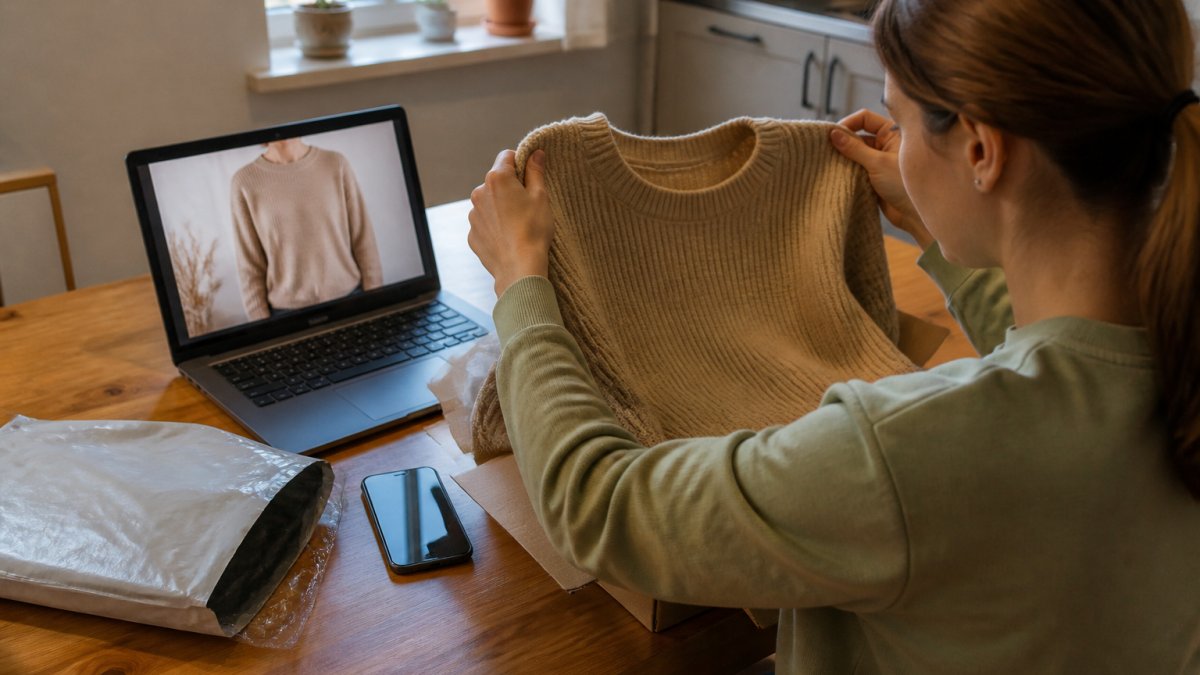
The Evidence Standard: What Actually Holds Up in a Dispute
A photo of a damaged item is weak evidence. A photo of the damaged item next to the shipping label, with the listing screenshot visible in the same frame, is strong evidence. The difference is context: it ties the defect to the specific order and the specific promise the seller made.
Capture these five things before you discard any packaging:
- The sealed parcel with the shipping label legible, photographed before opening.
- The item against the listing, a screenshot of the listing specs and photos next to the delivered item in one frame.
- Close-ups of any defect with a scale reference (a coin or ruler works).
- The packaging and inserts, including any authentication tag, seal, or care label.
- The order confirmation and any pre-purchase chat with the seller, saved as a file, not just left in an inbox.
Timing: The Windows That Matter
Three clocks start when the parcel arrives, and they are not the same length:
- The marketplace or seller return window is usually the shortest and is the one you must act within first.
- Your statutory rights (for example, under UK consumer law, the 14-day right to cancel for distance sales and the right to reject faulty goods) run on their own timetable and are not replaced by the seller's policy.
- The manufacturer warranty is the longest and is usually handled separately from the return.
A common pattern is a shopper who waits for the warranty to resolve a dead-on-arrival item and misses the return window. Report the fault to the seller inside the return window even if you also intend to claim the warranty.
Citizens Advice on returning faulty goods
Warranty and Repairability as Quality Signals
Warranty terms are a proxy for quality you can read before and after purchase. A long warranty with clear exclusions suggests the maker expects the item to last. A 30-day warranty on an appliance is a signal in itself.
Check these warranty mechanics after delivery:
- Registration deadline: many warranties require registration within a set period; miss it and the cover lapses.
- Who honors it: the seller, the manufacturer, or a third party. A warranty honored only by a seller who may disappear is weaker than a manufacturer-backed one.
- Parts availability: for anything repairable, check whether replacement parts are sold and at what price.
If the Item Fails: A Short Escalation Path
- Report the fault to the seller in writing inside the return window, with your evidence attached.
- If the seller does not resolve it, escalate to the payment provider (card chargeback or marketplace dispute) with the same evidence file.
- For statutory rights, use the consumer protection body in your country; in the UK, Citizens Advice can point you to the right route.
- Keep every message. A paper trail is what turns a complaint into a refund.
Inspection is not a single moment. It is a short window where you capture context-rich evidence, note the three deadlines, and register the warranty. Do those three things and most disputes resolve in your favor without escalation.
Shop With Confidence at Theclothes.club
Verifying product quality takes a few minutes, and it saves far more than it costs. Run the three checks, quality, authenticity and seller legitimacy, before you pay.
At Theclothes.club, we built our store around that idea. You get a curated selection across fashion, electronics, beauty, home and pet supplies, so you are not browsing five sites to find one item.
Ready to shop smarter? Get started with Theclothes.club and find quality products you can check, trust and enjoy.
Frequently Asked Questions
How can you assess product quality when you cannot inspect it in person?
Work through the listing first: check the material or component specifications, look at real customer photos rather than studio shots, and read reviews that mention durability and fit. Then verify the seller's contact details, return policy and secure HTTPS checkout. Before paying, compare the price with other retailers; an unusually large discount is a warning sign. After delivery, inspect the item within the returns window and photograph any faults so you have evidence if you need to claim.
How can you spot fake or misleading product reviews?
Look for generic praise with no specifics, repeated phrases across several reviews, and a burst of five-star ratings posted within a few days. Genuine feedback usually mentions a concrete detail such as sizing, battery life or stitching. Sort reviews by newest and by lowest rating to see the full picture, and check whether the reviewer has other activity on the site. Reviews that only describe delivery speed tell you nothing about product quality.
How to check if a product is genuine before ordering?
Start with the manufacturer's official website and confirm the model or product name matches the listing exactly. Check whether the brand uses authentication features such as QR codes, holographic labels or tamper-proof seals, and read the listing to see if those are described. Verify the seller is an authorised stockist by checking the brand's own store locator or stockist page. If the price is far below every other retailer, treat authenticity as unproven until you have more evidence.
What should you check in a product listing before placing an order?
Check the full specification: materials, dimensions, weight and compatibility. Read the returns and refund policy, and confirm the seller lists a physical address, phone number and business information. Look for HTTPS and a secure checkout, and see whether purchase protection applies. Compare the stated original price with the current price to spot inflated discounts. Finally, match the photos against customer-submitted images to see whether the product looks the same in real life.


