


Table of Contents
- Why Affordable Beauty Products for Everyday Use Make Sense
- Affordable Everyday Makeup: Build Your Base Without Overspending
- Affordable Skincare Products for Daily Care
- Inexpensive Beauty Product Alternatives: Dupes That Deliver
- Your Everyday Beauty Routine on a Budget: Step-by-Step
- How to Choose Affordable Beauty Products That Work for Your Skin
- Conclusion
- Frequently Asked Questions
Last Updated: October 21, 2026
Why Affordable Beauty Products for Everyday Use Make Sense
Affordable beauty products for everyday use are the backbone of any sensible routine, they let you look polished daily without treating a concealer purchase like a financial decision.
A daily routine reuses the same handful of items, so cost per use matters far more than sticker price.
Below, we break down the affordable everyday makeup and skincare picks worth buying, plus a routine you can copy.
Affordable Everyday Makeup: Build Your Base Without Overspending
Your base is where budget makeup earns or loses its reputation. A low-cost foundation or concealer works when the formula suits your skin type and the shade matches, and fails when you buy on price alone.
Concealer and Foundation That Last
Look for buildable coverage rather than maximum pigment: a medium-coverage concealer you can layer handles both a light everyday look and a spot touch-up. For foundation, match to your jawline in daylight and swatch several tones before committing.
Longevity comes down to prep: moisturised skin holds base makeup better than dry skin, and a light setting step keeps it in place through a workday.
Blush, Bronzer, and Lip Color Picks
These are the categories where inexpensive beauty product alternatives shine brightest. A cream blush blends with your fingers, works on lips too, and costs far less than a prestige powder; one lip color you love gets more use than a palette of ten you ignore.
Buy one of each, use it up, then replace, it keeps your routine lean and your spending predictable.
Affordable Skincare Products for Daily Care
Daily skincare is the foundation the rest of your routine sits on, and the category where drugstore aisles deliver the most value. You do not need ten steps, you need three products you will actually use every day.
Cleanser, Moisturizer, and SPF Essentials
- Cleanser: a gentle, non-stripping formula suited to your skin type. If your skin feels tight after washing, the cleanser is too harsh.
- Moisturizer: light and hydrating for daytime, richer at night if your skin needs it.
- SPF: the one non-negotiable. Daily sun protection prevents far more visible ageing than any serum on the shelf.
A common mistake is buying an active ingredient product before the basics are in place. Get the three essentials right first, then add a treatment for texture or dullness one product at a time so you can tell what is working.
Inexpensive Beauty Product Alternatives: Dupes That Deliver
A dupe is a low-cost product that mimics the finish, texture, or shade of a pricier one. The best dupes match the experience, not just the colour: same wear time, blendability, and comfort on the skin. Here is how to tell a real dupe from a lookalike.
Why Dupes Exist (and Where the Money Goes)
Contract manufacturers often produce formulas for several brands at once, so the same base emulsion, pigment dispersion, or liner polymer can appear under a budget label and a prestige one. What changes is usually packaging, fragrance, shade range, marketing spend, and quality-control tolerance, not always the core formula. Compare the first five or six ingredients on the label rather than the logo on the cap.
How to Vet a Dupe Before You Buy
Use a repeatable check:
- Match the finish, not the photo. A matte liquid lipstick and a satin one are not dupes even if the swatch looks identical online. Confirm the finish words (matte, satin, dewy, natural) match the pricier item.
- Compare wear claims against your day. If the original is marketed as 12-hour and the budget option says 6-hour, it is a different product for a different use. For everyday wear, a 6-8 hour claim is usually enough; for events, it is not.
- Check the shade range before you commit. A dupe that only comes in five tones is not a dupe for everyone. Look for a line that publishes its full range and swatches on multiple skin tones.
- Read the ingredient list for your triggers. If you are sensitive to fragrance or drying alcohols, a cheaper formula that leans on them will cost you more in irritation than it saves.
- Do a cost-per-use check. Divide the price by the uses you realistically expect. A budget liner replaced every six weeks can cost more per use than a mid-priced one lasting six months.
Where Budget Alternatives Genuinely Deliver
Some categories reward a lower spend far more than others, because the formula is simple and the cost is mostly packaging:
| Category | What to look for | What to skip | Why the budget version often works |
|---|---|---|---|
| Liquid liner | Fine brush tip, smudge-resistant finish, quick-dry polymer | Anything that flakes after a few hours | The core technology (film former plus pigment) is widely available; the brush tip matters more than the brand |
| Concealer | Buildable medium coverage, shade match, flexible finish | Ultra-full coverage that creases | Medium coverage is easier to formulate consistently at low cost than full coverage |
| Blush | Cream or soft powder, blendable, buildable pigment | Chalky powders that sit on top of skin | Cream formulas are simple emulsions; blendability is a texture issue, not a price issue |
| Color pencil | Creamy glide, long wear, no tug | Dry pencils that drag at the lid | Wax-to-oil ratio drives glide, and it is cheap to get right |
| Manicure | Quick-dry formula, good brush, flexible film | Formulas that chip within a day | Chip resistance comes from the film former, which is not inherently expensive |
Where to Spend Instead
Not every category is a dupe opportunity. Base products where shade match and undertone are critical (foundation, tinted moisturiser) and active treatments (retinoids, acids, vitamin C) are harder to match at the low end, because the active's stability and concentration drive both cost and results. Save on colour and tools; spend a little more on the one or two products that sit on your skin all day.
Your Everyday Beauty Routine on a Budget: Step-by-Step
Here is a complete everyday routine organised by step and product type. Total time is about ten minutes, and every item is a budget-friendly pick, the routine to build around when you want affordable beauty that holds up on a normal Tuesday.
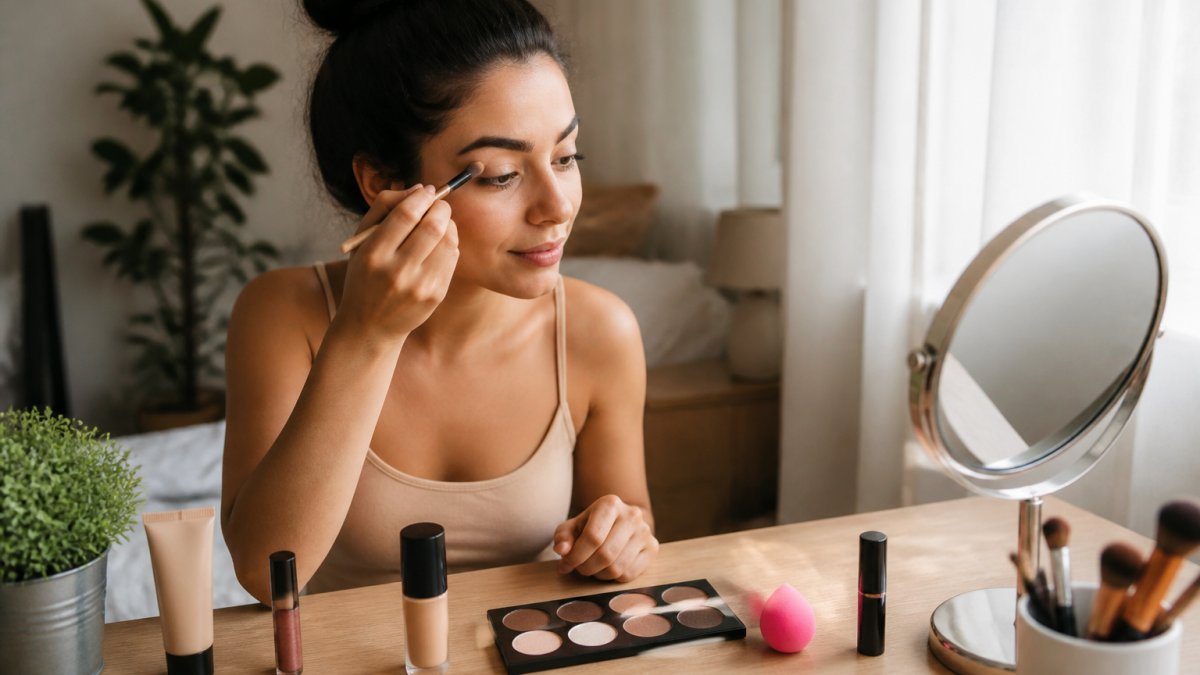
- Cleanse (1 minute): gentle cleanser, lukewarm water.
- Moisturise and protect (1 minute): moisturizer, then SPF.
- Prime the base (1 minute): a light layer of moisturiser or primer where makeup tends to slip.
- Conceal (2 minutes): spot-apply and blend with fingertips or a damp sponge.
- Even the base (2 minutes): light foundation or tinted moisturiser, blended outward.
- Add colour (2 minutes): cream blush on cheeks, a touch on lips.
- Define (1 minute): a soft color pencil along the lash line, or a quick liquid liner flick.
- Set and finish (1 minute): light powder only where you shine.
Eight steps, ten minutes, and a routine built entirely from affordable everyday makeup and skincare. The cost-per-use math works in your favour because you are buying fewer, better-chosen items.
How to Choose Affordable Beauty Products That Work for Your Skin
The right affordable beauty product matches your skin type, tone, and sensitivity, then survives a cost-per-use test. Here is the decision order, plus the sensitivity and ingredient checks most guides skip.
Step 1: Start With Skin Type, Then Tone, Then Sensitivity
That order prevents most bad purchases: skin type decides texture and finish, tone decides shade match, sensitivity decides which formulas to avoid.
By skin type: oily skin does better with matte, oil-free formulas and light gel moisturisers; dry skin needs creamier textures and hydrating bases; combination skin can mix a mattifying powder with a hydrating moisturiser. Oil-control formulas use powders and film formers to absorb sebum; hydrating ones rely on humectants (like glycerin) and occlusives to hold water in.
By tone: check that the shade range actually covers your tone before you buy, and swatch in daylight.
By sensitivity: if your skin reacts easily, patch-test new products and favour fragrance-free formulas, ingredient lists matter more than marketing claims.
Step 2: Read the Label Like a Budget Buyer
You do not need a chemistry degree, but three habits catch most problems:
- Check the first five ingredients. They are listed in descending order of concentration, so they tell you what the product mostly is. If a "hydrating" moisturiser lists alcohol high up, it may feel light but dry you out over the day.
- Know your trigger ingredients. Fragrance and essential oils are common irritants; drying alcohols and some preservatives affect sensitive skin. If you have reacted before, note the ingredient and scan for it.
- Treat claims as claims. "Dermatologist-tested" and "clean" are marketing terms with no single legal definition in most markets. They are not safety guarantees. As the FDA's guidance on cosmetics notes, cosmetic products are not reviewed for safety before sale, so reading labels and patch-testing is on you.
Step 3: Judge Value by Cost Per Use, Not Sticker Price
This is the gap most budget guides miss. A product's real cost is its price divided by the uses you get. A budget cleanser you finish in six weeks can cost more per use than a slightly pricier one lasting three months, and a cheap product you abandon after two tries costs infinitely more per use than either.
A simple way to budget an everyday routine:
| Routine category | What to prioritise | Budget-friendly approach |
|---|---|---|
| Cleanser | Gentle, non-stripping, suits your skin type | Buy the largest size you will finish; avoid harsh foaming formulas |
| Moisturiser | Humectant plus occlusive balance for your skin | One daytime, one richer night option if needed |
| SPF | Broad-spectrum, texture you will actually wear daily | The best SPF is the one you reapply; texture drives compliance |
| Base | Shade match and finish over coverage | Spend a little more here if you must; it sits on your skin all day |
| Colour (blush, lip, liner) | Blendability and wear time | Save here; formulas are simple and dupes are reliable |
Track one week of use for any new product. If you reach for it daily, it is earning its place; if it sits untouched, it was a false economy regardless of price.
Step 4: Check Availability, Shade Range, and Packaging
Availability and packaging count too. For broader context on what to look for in a cosmetics label, the EU Cosmetics Regulation overview is a useful reference point on ingredient disclosure, and Mintel's beauty and personal care research tracks how budget and premium formulas are converging.
That is why we curate our beauty range at Theclothes.club around everyday essentials rather than novelty. Our free membership gives you access to exclusive deals and new arrivals, so you can restock the products you rely on without hunting across multiple retailers.
Conclusion
Building a routine on affordable beauty products for everyday use is not a compromise. It is a smarter way to shop: fewer items, chosen for your skin, used until they are gone.
If you want a curated place to restock your everyday essentials, Theclothes.club brings beauty, fashion, and lifestyle products together in one convenient store, with great value across the range and a free membership for exclusive deals and new arrivals.
Frequently Asked Questions
What are the best affordable beauty products for everyday use?
The best affordable beauty products for everyday use focus on multi-purpose items: a lightweight concealer, a cream blush, a tinted moisturizer with SPF, and a gentle cleanser. Look for products that suit your skin type and offer a natural finish. Brands at lower price points now use high-performing formulas, so you can build a full routine without spending much. Check Theclothes.club's beauty section for curated options that balance quality and value.
How can I build an affordable everyday beauty routine?
Start with skincare essentials: a gentle cleanser, a basic moisturizer, and a broad-spectrum SPF. For makeup, choose a concealer, a cream blush, and a lip tint that can double as a cheek color. Add a liquid liner or color pencil if you want definition. By focusing on versatile products and avoiding duplicate items, you keep costs low. Track cost per use to see which items deliver the most value over time.
Which budget beauty products are worth buying?
Worthwhile budget beauty products are those that perform consistently and suit your skin. Prioritize items you use daily: foundation or tinted moisturizer, concealer, mascara, and cleanser. Read editor-tested reviews and look for products with transparent ingredient lists. Inexpensive beauty product alternatives often match high-end formulas for wear time and finish. At Theclothes.club, you can find a curated selection of such products under one roof.
Can inexpensive beauty products work as well as high-end products?
Yes, many inexpensive beauty products work as well as high-end ones, especially for everyday use. The key is to check the ingredient list and product performance rather than price alone. Affordable skincare products often contain the same active ingredients, like hyaluronic acid or niacinamide, at lower concentrations. For makeup, drugstore formulas have improved significantly in wear time and shade range. Always patch-test new products and read customer reviews to confirm quality.


